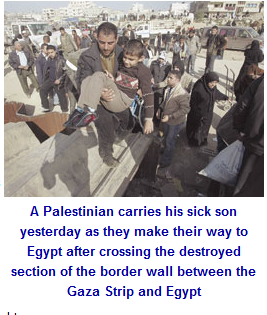
Svensk media vägrar ju att uppmärksamma lidandet och den kollektiva bestraffning av civilbefolkningen i Gaza. Men notera vilka det var som slog sig in till Egypten. Svältande och sjuka människor desperata på jakt efter mediciner. Varför tillåts Israel föra krig mot 20 månader gamla bebisar medan världen tittar på?
Och varför har Israelerna glömt sin historia?
Läs berättelsen på engelska om revolten i Sobibor och fundera på betydelsen av att stänga in en hel befolkning bakom murar och taggtråd med. Jag gör inga jämförelser med nazister och Israeler, bara med människosynen. Eller har arabiska liv mindre värde än judiska? Gaza är inget dödsläger men ett konsentrationsläger med över en miljon innevånare. Och innan någon pratar om Hamas attacker mot Israel läs om det Hudna förslag som Hamas 2006 gav Israel. Vilket både Israel och världen i övrigt ignorerade.
Pause for Peace – New York Times
We Palestinians are prepared to enter into a hudna to bring about an
immediate end to the occupation and to initiate a period of peaceful
coexistence during which both sides would refrain from any form of
military aggression or provocation. During this period of calm and
negotiation we can address the important issues like the right of
return and the release of prisoners. If the negotiations fail to
achieve a durable settlement, the next generation of Palestinians and
Israelis will have to decide whether or not to renew the hudna and the
search for a negotiated peace.
Shortly after Yom Kippur in 1943,
a group of Jewish prisoners in the Sobibor extermination camp,
determined to live rather than die, began devising a plan for
a revolt. A couple of days later, during the afternoon of 14
October 1943, one of the most daring displays of Jewish
resistance during the Holocaust began—the escape from Sobibor.
Gulf Times – Qatar’s top-selling English daily newspaper – Gulf/Arab World
RAFAH, Egypt: Abu Abdullah
wanted only one thing when he crossed through the shattered wall into
Egypt – a vaccine for his baby boy that can’t be found in the
neighbouring Gaza Strip.
“He’s 20 months old and
should have had his German measles jab five months ago, but you can’t
find it anywhere in Gaza because of the Israeli blockade,” he says,
cradling his child while the pharmacist searches for the precious
liquid.
Abu Abdullah is among an estimated 700,000 Palestinians who
have crossed the border from the isolated enclave since the towering
concrete wall separating the Gaza Strip from Egypt was blown up Tuesday
night.
Most come for petrol, cigarettes, cooking oil and other
staples, but Abu Abdullah says that once he has the vaccine, he’ll be
going back without any of the products he could sell on the lucrative
black market at home.
“Once I have the jab, I don’t need anything else from here, just my son’s health.”
White-bearded
pharmacist Hajj Khalil sits outside his store, dumbfounded by the rush
on his stocks which have left its shelves virtually empty, like those
of many others in the divided border town of Rafah.
“They want everything because there’s nothing in Gaza,” he says.
“The
only things I have left are beauty products. Antibiotics sold out the
quickest. Now I’ve sold everything and I’m waiting for more stocks to
come from Cairo.”
Hundreds of parents of young children, others
pushing elderly relatives in wheelchairs, push through the thronging
crowds of Palestinian shoppers on Rafah’s main Salaheddin Street to get
medicine.
“I did $5,000 worth of business yesterday, more than I
make in a month normally, says a pharmacist who gives only his first
name Mohamed.
“I give a discount to people who are obviously poor.
The most popular drugs are for cancer therapy, hypertension, sclerosis
of the liver.
“Some Palestinian ambulances came through yesterday bringing victims of the intifada to be treated here.”
Dr Yussef Musallam has come from Gaza City with $1,000 to spend on drugs to take back to his pharmacy.
“I’m
going to buy all the drugs I can, we have nothing in Gaza because of
the siege. In spite of the tunnels, the siege hit us badly. I’ve got
$1,000, which is everything I have.
“It used to take one day to ask
for drugs from the Israelis but since the siege, it takes one month, if
they allow it at all, they refuse a lot of orders.”
Even before the
complete lockdown imposed by Israel last Thursday, the World Health
Organisation was expressing alarm at Gaza’s deepening isolation and
accused Israel of putting lives in danger by not allowing dozens of
patients to leave for treatment.
The UN agency said last month that
23% of requests in October for treatment in Israel were refused,
compared with 17 % in September and 10% in June, when Hamas seized
control of Gaza from forces loyal to Palestinian President Mahmoud
Abbas.
Läs mer i Svd